What’s inside
Everything you need.
Nothing you don’t.
Ten tools, one craft. Every card opens the full story.
Rehearsal Studio
Off-Book reads the other lines. You play yours.
Off-Book reads Algernon
Performance Voices
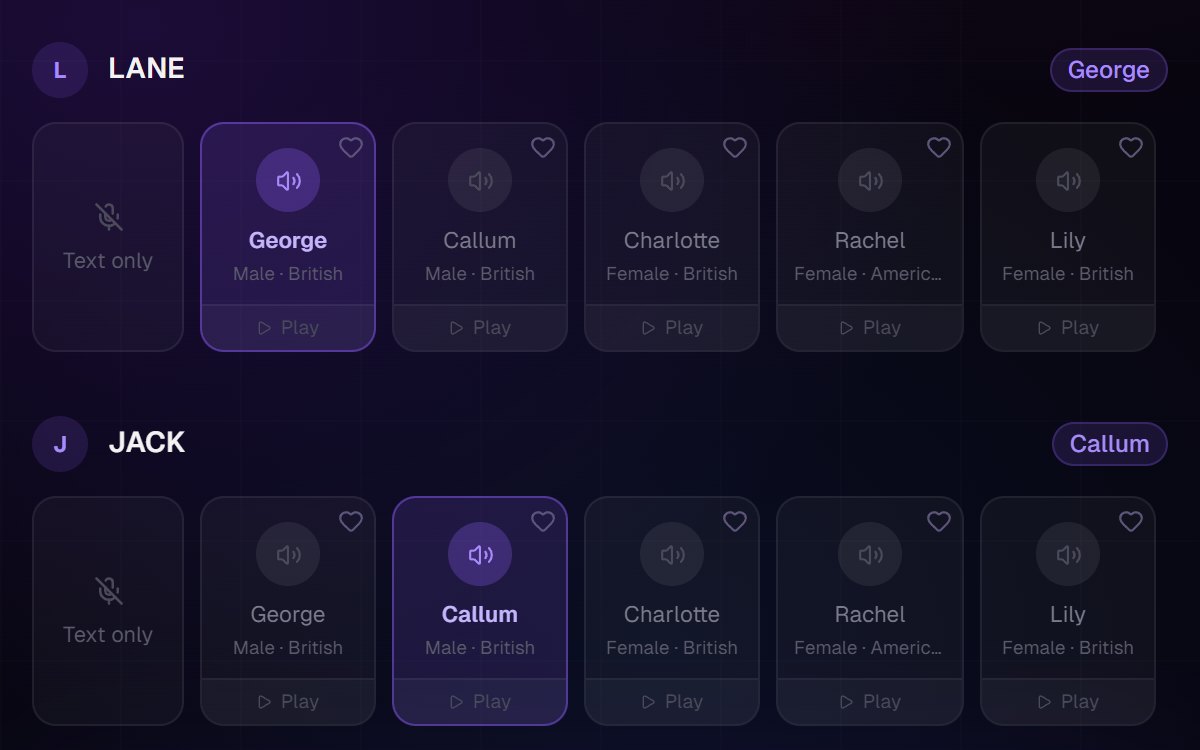
A cast for your scene, not one narrator.
Choose a voice for every other part, hear each one before you choose, and keep the ones that suit the parts you play. Off-Book reads the other lines in the voices you gave them, so you have someone to answer. Your own part is never read aloud.
Script Actioning
Actioning, finally done right.
Assign a transitive verb to every speech: what your character is doing, not feeling. Your verbs sit beside the lines like pencil notes, the text itself never touched. Stuck on a beat? Browse a library of hundreds of playable actions, grouped by what the character wants and searchable by the verb or the feeling. You choose.

Units & Objectives
Stanislavski's scene work, on the actual script.
Click between lines to split a scene into units and write a playable objective for every character in each one. Take them into the Rehearsal Studio: with objectives on, each part's objective goes into how its line is read. Saved work survives re-uploads, because units reference lines by identity, not position.

Script Quiz
Prove you're actually off book.
Your scene becomes a deck of cards: the other character's cue on top, your line from memory. Say it right and it chimes, glows green, and glides to the next card by itself. Shuffle the deck to find the lines that can't stand alone yet.
Explore the Script Quiz
Scripts
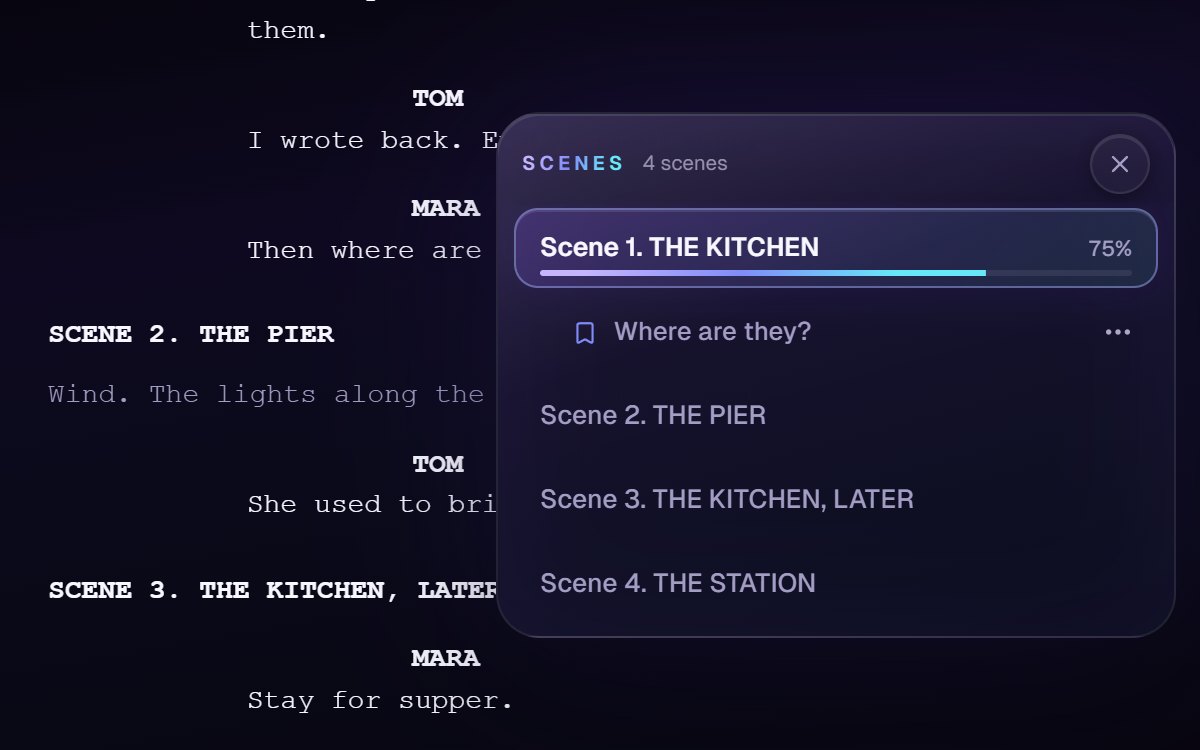
Every scene, one tap away.
Upload a PDF, Word, Final Draft or Fountain script and read it as a clean page on any screen. Scene Jump takes you to any scene, shows how far through each one you are, and keeps a checkpoint where you stopped.
Reading mode
Read the script the way that suits you.
Comfort settings for how the script looks on your device, free for everyone. Some readers, including some with dyslexia or ADHD, find it easier to keep their place with the start of each word in bold. Others prefer the OpenDyslexic typeface. Try them and see. The words themselves never change.

Off-Book Pro
Rehearse out loud as much as you like.
The craft tools are free and unlimited. Pro lifts the monthly caps on rehearsing and quizzing, and adds the tools below.
Save 48% with yearly£75 a year, which is £6.25 a month, against £12 a month paid monthly.
What Pro adds

Script analytics
Your whole script, broken down: who carries it, by lines and words, and every scene, location and prop, with the words said most.

Script Photo Capture
Photograph a paper script and Off-Book reads it in, page by page. A cut or a change written on the page in pen is read too. You check every line before it saves.
Start your 7-day free trial
Free for 7 days, then £12 a month or £75 a year. Cancel anytime before it ends and you pay nothing.
Start your 7-day free trialFree
- Unlimited script uploads
- Units, objectives and actioning
- Character profiles
- 5 new rehearsal scenes/month, replays unlimited
- 5 quiz sessions/month
- Self-guided warm-ups
Pro
- Unlimited script uploads
- Units, objectives and actioning
- Character profiles
- Unlimited rehearsal scenes
- Unlimited quiz sessions
- Voice-guided warm-ups
- Footer-free script exports (PDF and print)
- Early Access features (opt in)
- Script Photo Capture
- Choose your theme (Light, Dark, Off-Book Classic)
Starts with a 7-day free trial
How it works
Three steps to the performance of your life.
Upload your script
PDF, Word, Final Draft or Fountain. Off-Book breaks it into scenes, characters and dialogue instantly.
Do the work
Action it, break it into units, build the character, quiz your lines, run the scene with Off-Book.
Walk in ready
Accuracy trends, saved sessions, warm-ups before you go. Arrive prepared, every time.
Built by actors, for actors
Built by a working actor,
not a product team.
Off-Book was founded because I found myself juggling actor tools everywhere. Scripts here, notes there, warm-up routines in one app, character work in another, and never in one seamless space. Every project meant hunting through documents, apps and notebooks, losing creative momentum in the chaos of organisation.
I wanted something that understood what actors actually need: units and objectives, actioning, cued line runs. The real work, not a note-taking app with a theatre mask on the icon.
Nelly Azeez, Founder
Read the full storyQuestions actors ask
Getting off book, answered.
What does being off book mean?
Off book means you can play the scene without the script in your hand. It is not the same as having memorised the words. You are off book when your line arrives on cue, in response to what the other character has just done, while your attention is on them rather than on remembering.
How do I get off book?
Learn the lines in the shape you will perform them: out loud, on your feet, and triggered by a cue rather than read off the page. Run the scene often and in short sittings rather than once for an hour. Test yourself against the cue line rather than the whole speech, because the cue is what has to fire the words on the night.
How do actors run lines alone?
They run them against something that speaks the other roles, so the cue arrives without them reading both halves of the scene. Reading both parts yourself teaches your ear the wrong rhythm, because your line stops being a response and becomes the next thing on the page. Off-Book reads the other lines aloud, listens while you act, and comes in the moment you land your last word.
How do you memorise lines without a scene partner?
Work from the cue, not the page. Cover your line, take the cue that comes before it, and say yours from memory; when it comes back wrong, look, then go again. Shuffle the order so you are learning the lines rather than the sequence. The words have to be attached to what prompts them, not to their position on the page.
How long does it take to learn a part?
There is no honest number: it depends on the length, the density of the language and how much of the scene you have worked out. What reliably shortens it is doing the scene work first. Once you know what your character wants in each unit and what each line is doing to the other person, the words have somewhere to attach and stop being a list to remember.
How should I prepare for a drama school audition?
Choose speeches you can play rather than ones that impress on paper, then do the work underneath the words: break each speech into units, give every unit an objective, and name the action on each thought. Get off book early enough that the last week is about playing it rather than remembering it. Then run it with a real person before the day.
Should I use an app to film my self-tape?
No, and we are direct about this inside the app too: for the take itself, find a real reader. A person listens back, adjusts to you, and gives the scene something no tool can. Off-Book is for the work before that moment, getting you off book and keeping the scene warm, so that when your reader arrives you can act instead of remembering.
Begin
Ready to go off book?
Free to try, no card needed. Your first scene is two minutes away.
Free forever on the craft tools.